
碳排放精准表征
-
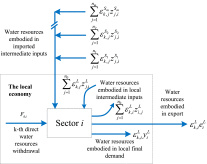
Multi-scale input-output analysis of consumption-based water resources: Method and application
This work develops a method of multi-scale input-output analysis for the embodied water accounting of an economy. This method can distinguish between the different virtual water contents of imported and local products and is therefore capable of estimating the virtual water that is embodied in trade. As a simplified model rather than a multi-regional input-output analysis, this method substantially minimizes the data requirements. With t...
-
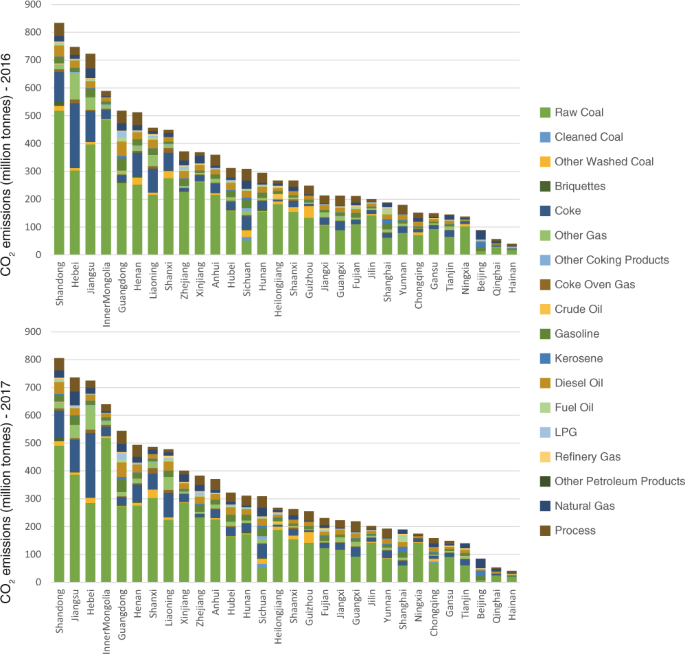
Methodology and applications of city level CO2 emission accounts in China
China is the world's largest energy consumer and CO 2 emitter . Cities contribute 85% of the total CO 2 emissions in China and thus are considered as the key areas for implementing policies designed for climate change adaption and CO 2 emission mitigation. However, the emission inventory construction of Chinese cities has not been well researched, mainly owing to the lack of systematic statistics and poor data quality. Focusing on this r...
-
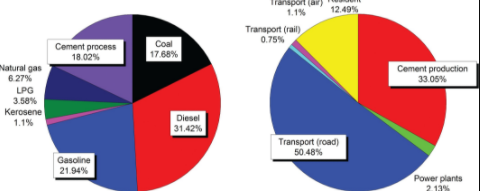
Energy consumption and CO2 emissions in Tibet and its cities in 2014: Tibet CO2 emissions in 2014
Because of its low level of energy consumption and the small scale of its industrial development, the Tibet Autonomous Region has historically been excluded from China’s reported energy statistics, including those regarding CO2 emissions. In this paper, we estimate Tibet’s energy consumption using limited online documents, and we calculate the 2014 energy-related and process-related CO2 emissions of Tibet and its seven prefecture-lev...
-
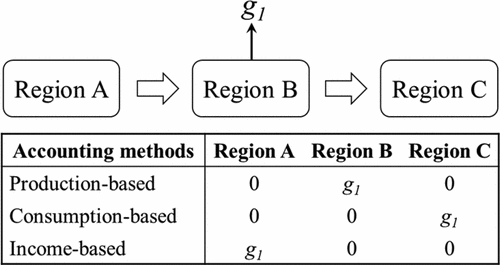
Income-Based Greenhouse Gas Emissions of Nations
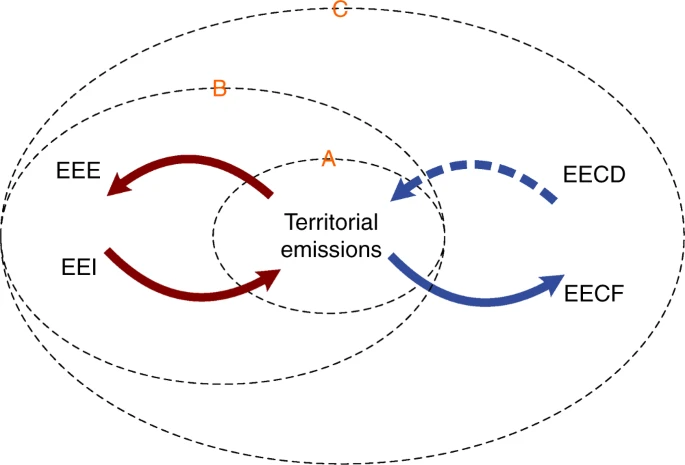
Accounting for greenhouse gas (GHG) emissions of nations is essential to understanding their importance to global climate change and help inform the policymaking on global GHG mitigation. Previous studies have made efforts to evaluate direct GHG emissions of nations (a.k.a. production-based accounting method) and GHG emissions caused by the final consumption of nations (a.k.a. consumption-based accounting method), but overlooked downstre...
-
Consumption-based greenhouse gas emissions accounting with capital stock change highlights dynamics of
Traditional consumption-based greenhouse gas emissions accounting attributed the gap between consumption-based and production-based emissions to international trade. Yet few attempts have analyzed the temporal deviation between current emissions and future con-sumption, which can be explained through changes in capital stock. Here we develop a dynamic model to incorporate capital stock change in consumption-based accounting. The new mode...
-
Variations of China's emission estimates: Response to uncertainties in energy statistics
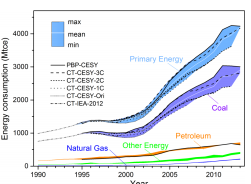
The accuracy of China's energy statistics is of great concern because it contributes greatly to the uncertainties in estimates of global emissions. This study attempts to improve the understanding of uncertainties in China's energy statistics and evaluate their impacts on China's emissions during the period of 1990–2013. We employed the Multi-resolution Emission Inventory for China (MEIC) model to calculate China's emissions based on d...
-
Unequal household carbon footprints in China
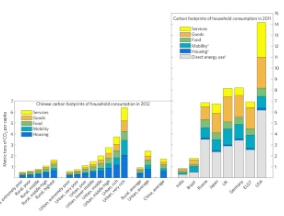
Households’ carbon footprints are unequally distributed among the rich and poor due to differences in the scale and patterns of consumption. We present distributional focused carbon footprints for Chinese households and use a carbon-footprint-Gini coefficient to quantify inequalities. We find that in 2012 the urban very rich, comprising 5% of population, induced 19% of the total carbon footprint from household consumption in China, wi...
-
Carbon emissions from fossil fuel consumption of Beijing in 2012
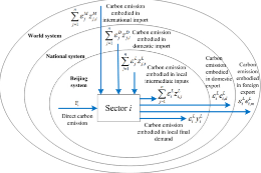
The present study analyzed the consumption-based carbon emissions from fossil fuel consumption of Beijing in 2012. The multi-scale input–output analysis method was applied. It is capable of tracing the carbon emissions embodied in imports based on a global multi-regional input–output analysis using Eora data. The results show that the consumption-based carbon emission of Beijing has increased by 18% since 2007, which is 2.57 times hi...
-
Consumption-based emission accounting for Chinese cities
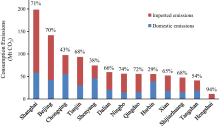
Most of China’s CO 2 emissions are related to energy consumption in its cities. Thus, cities are critical for implementing China’s carbon emissions mitigation policies. In this study, we employ an input-output model to calculate consumption-based CO 2 emissions for thirteen Chinese cities and find substantial differences between production- and consumption-based accounting in terms of both overall and per capita carbon emissions. Ur...
-
New provincial CO2 emission inventories in China based on apparent energy consumption data and updated
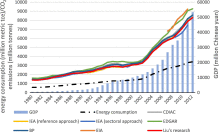
This study employs “apparent energy consumption” approach and updated emissions factors to re-calculate Chinese provincial CO 2 emissions during 2000–2012 to reduce the uncertainty in Chinese CO 2 emission estimates for the first time. The study presents the changing emission-socioeconomic features of each provinces as well. The results indicate that Chinese provincial aggregated CO 2 emissions calculated by the apparent energy con...