
碳排放精准表征
-
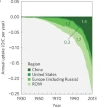
Substantial global carbon uptake by cement carbonation
Calcination of carbonate rocks during the manufacture of cement produced 5% of global CO2emissions from all industrial process and fossil-fuel combustion in 2013 1 , 2 . Considerable attention has been paid to quantifying these industrial process emissions from cement production 2 , 3 , but the natural reversal of the process—carbonation—has received little attention in carbon cycle studies. Here, we use new and existing data on cem...
-
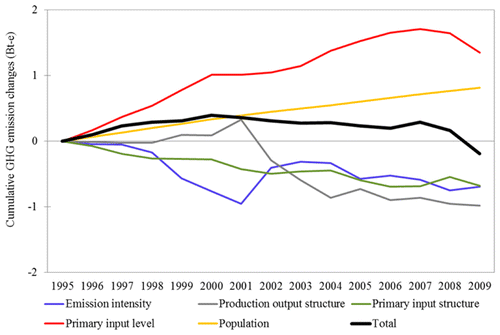
Socioeconomic Drivers of Greenhouse Gas Emissions in the United States
Existing studies examined the U.S.'s direct GHG emitters and final consumers driving upstream GHG emissions, but overlooked the U.S.'s primary suppliers enabling downstream GHG emissions and relative contributions of socioeconomic factors to GHG emission changes from the supply side. This study investigates GHG emissions of sectors in the U.S. from production-based (direct emissions), consumption-based (upstream emissions driven by final...
-
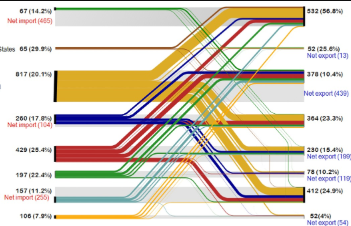
Virtual Water Flows in the EU27: A Consumption‐based Approach
The use of water resources has traditionally been studied by accounting for the volume of water removed from sources for specific uses. This approach focuses on surface and groundwater only and it ignores that international trade of products with substantial amounts of embodied water can have an impact on domestic water resources. Using current economic and environmental data, we conduct a consumption‐based assessment of virtual water ...
-
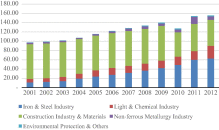
CO2 emissions from China’s lime industry
China is now the world’s leading energy consumer and CO 2 emitter; therefore, precise quantification of the CO 2 emissions that occur in China is of serious concern. Although most studies focus on CO 2 emissions from fossil fuel combustion and cement production, the emissions from lime production is not well researched. Lime production is the second largest source of carbon emissions from industrial processes after cement production. T...
-

Accounting for value added embodied in trade and consumption: an intercomparison of global multiregiona
Global multiregional input–output (MRIO) tables constitute detailed accounts of the economic activity worldwide. Global trade models based on MRIO tables are being used to calculate important economic and environmental indicators such as value added in trade or the carbon footprint of nations. Such applications are highly relevant in international trade and climate policy negotiations, and consequently MRIO model results are being scru...
-
Revisiting the Global Net Carbon Dioxide Emission Transfers by International Trade: The Impact of Trade
To revisit global net carbon dioxide (CO2) emissions transfers by international trade for year 2007, this study employs a new world-wide, multiregional input-output (MRIO) table in which China's production is separated into domestic use, processing exports, and nonprocessing exports. The results show that processing exports in China involves relatively lower CO2 emissions than other production types for the same output levels. Therefore...
-
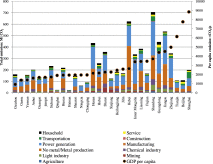
Four system boundaries for carbon accounts
Knowing the carbon emission baseline of a region is a precondition for any mitigation effort, but the baselines are highly dependent on the system boundaries for which they are calculated. On the basis of sectoral energy statistics and a nested provincial and global multi-regional input–output model, we calculate and compare four different system boundaries for China's 30 provinces and major cities. The results demonstrate significant ...
-
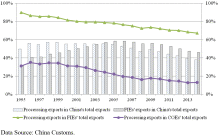
Firm ownership, China's export related emissions, and the responsibility issue
China's CO 2 emissions and those embodied in its exports have been extensively studied. One often neglected aspect is the prevalence of foreign-invested enterprises (FIEs) in China's exports, for which a substantial portion of benefits return to the investing countries. In this paper, we revisit China's export-related CO 2 emission responsibilities by viewing them from a “new”, gross national income perspective. Using a recently deve...
-
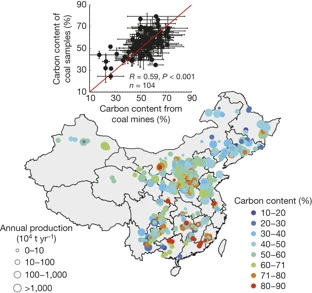
Reduced carbon emission estimates from fossil fuel combustion and cement production in China
Nearly three-quarters of the growth in global carbon emissions from the burning of fossil fuels and cement production between 2010 and 2012 occurred in China 1 , 2 . Yet estimates of Chinese emissions remain subject to large uncertainty; inventories of China’s total fossil fuel carbon emissions in 2008 differ by 0.3 gigatonnes of carbon, or 15 per cent 1 , 3 , 4 , 5 . The primary sources of this uncertainty are conflicting estimates of...
-
Estimating inter-regional trade flows in China: A sector-specific statistical model
China has huge differences among its regions in terms of socio-economic development, industrial structure, natural resource endowments, and technological advancement. These differences have created complicated linkages between regions in China. In this study, building upon gravity model and location quotient techniques, we develop a sector-specific model to estimate inter-provincial trade flows, which is the base for making a multi-regio...