
碳排放精准表征
-

A Hybrid‐Unit Energy Input‐Output Model to Evaluate Embodied Energy and Life Cycle Emissions for Ch
We develop a hybrid‐unit energy input‐output (I/O) model with a disaggregated electricity sector for China. The model replaces primary energy rows in monetary value, namely, coal, gas, crude oil, and renewable energy, with physical flow units in order to overcome errors associated with the proportionality assumption in environmental I/O analysis models. Model development and data use are explained and compared with other approaches i...
-
Input-Output Analysis: The Next 25 Years
This year marks the 25th anniversary of the International Input–Output Association and the 25th volume of Economic Systems Research . To celebrate this anniversary, a group of eight experts provide their views on the future of input–output. Looking forward, they foresee progress in terms of data collections, methods, theory testing, and focus and scope....
-
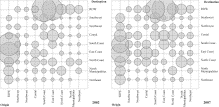
China’s inter-regional spillover of carbon emissions and domestic supply chains
In this study, we apply the inter-regional input–output model to explain the relationship between China’s inter-regional spillover of CO 2 emissions and domestic supply chains for 2002 and 2007. Based on this model, we propose alternative indicators such as the trade in CO 2 emissions, CO 2 emissions in trade and the regional trade balances of CO 2 emissions. Our results do not only reveal the nature and significance of inter-regiona...
-
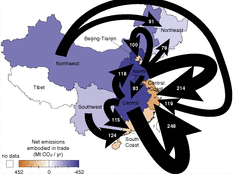
Outsourcing CO2 within China
Recent studies have shown that the high standard of living enjoyed by people in the richest countries often comes at the expense of CO2emissions produced with technologies of low efficiency in less affluent, developing countries. Less apparent is that this relationship between developed and developing can exist within a single country’s borders, with rich regions consuming and exporting high-value goods and services that depend upon p...
-
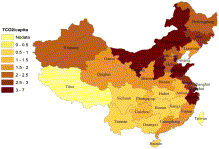
CO2 emissions from China’s power sector at the provincial level: Consumption versus production perspe
The Chinese electricity sector plays an important role in domestic CO 2 mitigation efforts due to its large contribution to overall emissions. However, primary energy resources used for electricity generation are not evenly distributed across the country. Such a supply and demand mismatch in reality results in large parts of electricity to be transferred from economically less developed provinces in the west to economic growth centres in...
-
Disaggregating the electricity sector of china’s input-output table for improved environmental life-c
Missing process detail of sectors in Input–Output (I–O) tables has been pointed out as a limitation of I–O analysis in environmental-economic life cycle assessment. Aggregation of resource-intensive sectors decreases the accuracy of the results. Often, economic sectors are compiled in a more aggregated form than environmental satellite accounts, and as [Lenzen, M. (2011) Aggregation Versus Disaggregation in Input–Output Analysis ...
-
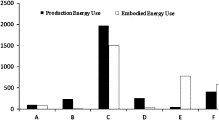
Embodied energy use in China's industrial sectors
As the world’s top energy consumer, China is facing a great challenge to solve its energy supply issue. In this paper energy use from all industrial sectors in China’s economy of 2007 was explored by conducting an extended environmental input–output analysis . We compare the energy consumption embodied in the final demand for goods and services from 29 sectors with the energy demand required for the actual production process in eac...
-
Uncovering China’s greenhouse gas emission from regional and sectoral perspectives
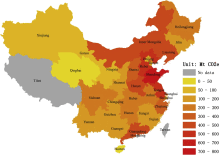
Understanding China’s GHG (greenhouse gas) emission status is critical for achieving the national mitigation plan. While much attention has addressed China’s national level GHG emission, less is known about its regional and sectoral emission features. In this paper China’s regional and sectoral GHG emission patterns and their driving forces were explored by using upgraded energy consumption data. We constructed a detailed GHG inven...
-
Disaggregating input-output models with incomplete information
Disaggregating a sector within the Leontief input–output (IO) framework is not a straightforward task since there is more than one possibility for the unknown technical coefficients of the disaggregated IO table, and more information than what is embodied in the aggregated IO table is thus required. This paper presents a methodology for disaggregating sectors into an arbitrary number of new sectors when the only available information a...
-
The gigatonne gap in China’s carbon dioxide inventories
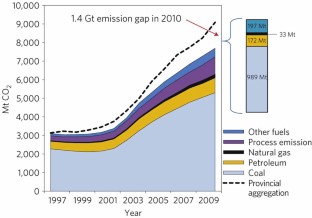
Reliable national statistics are fundamental for climate change science as well as for global negotiations about future emission targets and the allocation of responsibilities. China, the world’s top CO 2 emitter 1 , 2 , has frequently been questioned about its data transparency and accuracy of energy and emission statistics 3 , 4 , 5 , 6 , 7 . China implemented a top-down statistical system where energy statistics are compiled under t...