
多尺度差异化气候减缓路径
-

Comparative Analysis of Carbonization Drivers in China's Megacities
This study investigates the key drivers affecting emission increases in terms of population growth, economic growth, industrial transformation, and energy use in six Chinese megacities: Beijing, Shanghai, Tianjin, Chongqing, Guangzhou, and Hong Kong. The six cities represent the most‐developed regions in China and they have similar per capita carbon dioxide (CO 2 ) emissions as many developed countries. There is an urgent need to quant...
-
Analyzing Drivers of Regional Carbon Dioxide Emissions for China
China faces the challenge of balancing unprecedented economic growth and environmental sustainability. Rather than a homogenous country that can be analyzed at the national level, China is a vast country with significant regional differences in physical geography, regional economy, demographics, industry structure, and household consumption patterns. There are pronounced differences between the much‐developed Eastern‐Coastal economic...
-
Low-carbon development in the least developed region: a case study of Guangyuan, Sichuan province, sout
The Wenchuan earthquake in 2008 has resulted in 50% of Guangyuan city facing recovery from different extents of damages. The massive reconstruction provides a good opportunity for Guangyuan city to response to the National Council’s call for tackling climate change by developing a harmonised and low-carbon economy. However, there are many arguments about the definition of ‘low carbon’ and the framework that low-carbon development s...
-
A “Carbonizing Dragon”: China’s Fast Growing CO2 Emissions Revisited
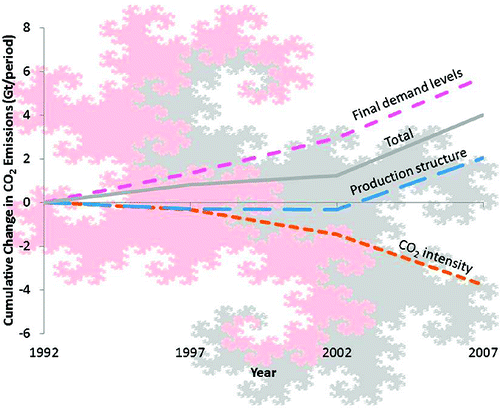
China’s annual CO 2 emissions grew by around 4 billion tonnes between 1992 and 2007. More than 70% of this increase occurred between 2002 and 2007. While growing export demand contributed more than 50% to the CO 2 emission growth between 2002 and 2005, capital investments have been responsible for 61% of emission growth in China between 2005 and 2007. We use structural decomposition analysis to identify the drivers for China’s emissi...
-
Preliminary exploration on low-carbon technology roadmap of China’s power sector
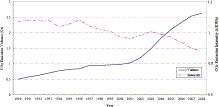
Climate change poses huge challenges to the sustainable development of human society. As a major CO2emission source, decarbonization of power sector is fundamental for CO2emission abatement. Therefore, considering the “carbon lock-in” effects, it’s critical to formulate an appropriate roadmap for low-carbon generation technologies. In this paper, key low-carbon technology solutions are firstly identified according to their develop...
-
Distributional Effects of Climate Change Taxation: The Case of the UK
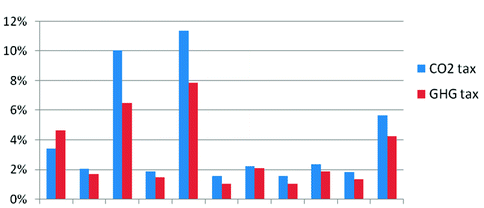
Current economic instruments aimed at climate change mitigation focus mainly on CO2emissions, but efficient climate mitigation needs to focus on other greenhouse gases as well as CO2. This study investigates the distributional effects of climate change taxes on households belonging to different income and lifestyle groups; and it compares the effects of a CO2tax with a multiple GHG tax in the UK in terms of cost efficiency and distribut...
-
Lifestyles, technology and CO2 emissions in China: A regional comparative analysis
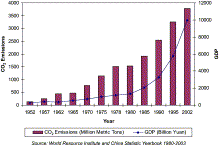
With rapid economic development, higher income levels, urbanization and other socio-economic drivers, people's lifestyles in China have changed remarkably over the last 50years. This paper uses the IPAT model (where I =Impact representing CO 2 emissions, P =Population, A =Affluence, and T =emission intensity) to analyze how these main drivers contributed to the growth of CO 2 emissions over this time period. Affluence or lifestyle chang...
-
Journey to world top emitter: An analysis of the driving forces of China's recent CO2 emissions surge
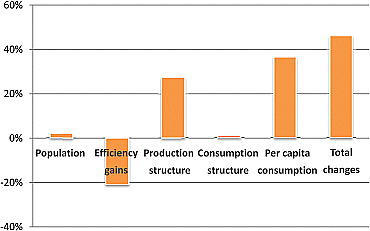
China's economy has been growing at an accelerated rate from 2002 to 2005 and with it China's carbon emissions. It is easier to understand the growth in China's carbon emissions by considering which consumption activities ‐ households and government, capital investments, and international trade ‐ drive Chinese production and hence emissions. This paper adopts structural decomposition analysis, a macro‐economic approach using data f...
-
The drivers of Chinese CO2 emissions from 1980 to 2030
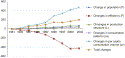
China's energy consumption doubled within the first 25 years of economic reforms initiated at the end of the 1970s, and doubled again in the past 5 years. It has resulted of a threefold CO 2 emissions increase since early of 1980s. China's heavy reliance on coal will make it the largest emitter of CO 2 in the world. By combining structural decomposition and input–output analysis we seek to assess the driving forces of China's CO 2 emis...
-
The contribution of Chinese exports to climate change
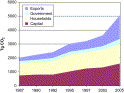
Within 5 years, China's CO 2 emissions have nearly doubled, and China may already be the world's largest emitter of CO 2 . Evidence suggests that exports could be a main cause for the rise in Chinese CO 2 emissions; however, no systematic study has analyzed this issue, especially over time. We find that in 2005, around one-third of Chinese emissions (1700Mt CO 2 ) were due to production of exports, and this proportion has risen from 12% ...