
多尺度差异化气候减缓路径
-

Cities: the core of climate change mitigation
Cities, the core of the global climate change mitigation and strategic low-carbon development, are shelters to more than half of the world population and responsible for three quarters of global energy consumption and greenhouse gas (GHG). This special volume (SV) provides a platform that promotes multi- and inter- disciplinary analyses and discussions on the climate change mitigation for cities. All papers are divided into four themes,...
-
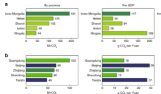
Chinese CO2 emission flows have reversed since the global financial crisis
This study seeks to estimate the carbon implications of recent changes in China's economic development patterns and role in global trade in the post-financial-crisis era. We utilised the latest socioeconomic datasets to compile China's 2012 multiregional input-output (MRIO) table. Environmentally extended input-output analysis and structural decomposition analysis (SDA) were applied to investigate the driving forces behind changes in CO ...
-
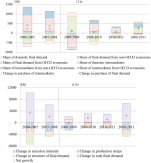
The global CO2 emissions growth after international crisis and the role of international trade
In this paper, we decompose the driving forces of global CO 2 emissions for the post-crisis era 2008–2011 from both production-based and consumption-based aspects. The results suggest that non-OECD economies have become the major drivers for the rapid global growth of CO 2 emissions after the crisis. More specifically, the increasing consumption and investment of non-OECD economies, as well as stagnation of their emission intensity red...
-
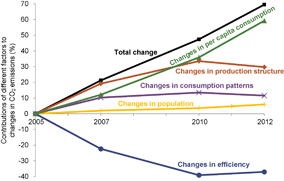
Pattern changes in determinants of Chinese emissions
The Chinese economy has been recovering slowly from the global financial crisis, but it cannot achieve the same rapid development of the pre-recession period. Instead, the country has entered a new phase of economic development—a 'new normal'. We use a structural decomposition analysis and environmental input–output analysis to estimate the determinants of China's carbon emission changes during 2005–2012. China's imports are linked...
-
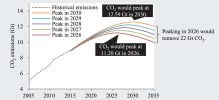
Socioeconomic impact assessment of China's CO2 emissions peak prior to 2030
China is the largest emitter of carbon emissions in the world. In this paper, we present an Integrated Model of Economy and Climate (IMEC), an optimization model based on the input-output model. The model is designed to assess the tradeoff between emission deceleration and economic growth. Given that China's projected average growth rate will exceed 5% over the next two decades, we find that China may reach its peak CO 2 emissions levels...
-
Environment-economy tradeoff for Beijing–Tianjin–Hebei’s exports
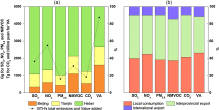
The trade of goods among regions or nations associated with large environmental consequences. Yet balancing economic gains and environmental consequences induced by trade is still hindered by a lack of quantification of these two factors, especially for the environmental problems those are more locally oriented, such as the atmospheric pollution. Based on an environmental input–output analysis for 2010, we contrast economic gains (valu...
-
Carbon emissions embodied in international trade: The post-China era
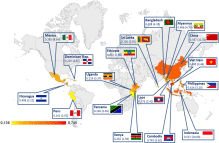
The so-called post-China countries (PC-16́s), distinguished by low wages and high economic growth, will replace China as the “world’s factory”. The aim of this paper is to assess the effect of these changes on global CO 2 emissions pathways. To achieve this, a counterfactual is proposed wherein China’s trade with the rest of the world is replaced by the PC-16’s trade in a global multiregional input–output context. The emissi...
-
Determinants of global CO2 emissions growth
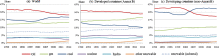
This paper analyzes global CO 2 emissions growth by fossil fuel type (coal, oil or gas), demand type (consumption or investment), country group (developed or developing country) and industry group. The results indicate that, among the three fossil fuels, CO 2 emissions from coal use grew the most rapidly in developing countries, by 3.76Gt in the period 1995–2009. By contrast, CO 2 emissions from natural gas use grew the most rapidly in...
-
Assessment of electrical vehicles as a successful driver for reducing CO2 emissions in China
This paper analyses the impacts of the gasoline vehicle replacement programme with EVs at different penetration rates on petroleum and electricity sectors and their CO 2 emissions. The study utilises a top-down-type Environmental Input–Output (EI–O) model. Our results show that the replacement of gasoline cars with EVs causes greater impacts on total gasoline production than on total electricity generation. For example, at 5%, 20%, 5...
-
Climate change mitigation in Chinese megacities: A measures-based analysis of opportunities in the resi
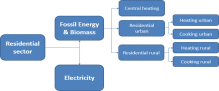
China’s commitment to the UNFCCC to peak its emissions by 2030, or sooner, signaled a long anticipated shift in China’s model of development with far reaching consequences. Cities in China, and particularly the residential sector in cities, will be charged with making significant reductions in emissions growth even as rates of urbanization continue to climb. Focusing on Beijing and Shanghai, this paper carries out a measures-based ec...