
气候风险评估与适应路径
-

Assessment of China's virtual air pollution transport embodied in trade by using a consumption-based em
Substantial anthropogenic emissions from China have resulted in serious air pollution, and this has generated considerable academic and public concern. The physical transport of air pollutants in the atmosphere has been extensively investigated; however, understanding the mechanisms how the pollutant was transferred through economic and trade activities remains a challenge. For the first time, we quantified and tracked China's air pollut...
-
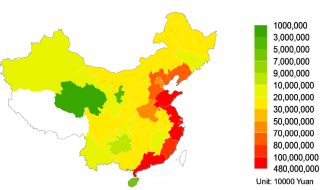
Revealing the Hidden Health Costs Embodied in Chinese Exports
China emits a considerable amount of air pollutants when producing goods for export. Previous efforts have emphasized the magnitude of export-related emissions; however, their health consequences on the Chinese population have not been quantified. Here, we present an interdisciplinary study to estimate the health impact of export-related air pollution. The results show that export-related emissions elevated the annual mean population wei...
-
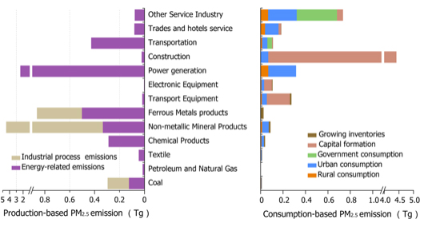
Tracing Primary PM2.5 emissions via Chinese supply chains
In this study, we examine a supply-chain approach to more effectively mitigate primary PM 2.5 emissions in China from the perspectives of production, consumption and their linkages using structural path analysis. We identify the pattern of all supply chain paths using principal component analysis. To address the severe haze problems in China, it is important to understand how final demand purchase initiates production processes and ulti...
-
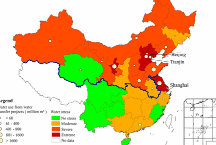
Physical and virtual water transfers for regional water stress alleviation in China
Water can be redistributed through, in physical terms, water transfer projects and virtually, embodied water for the production of traded products. Here, we explore whether such water redistributions can help mitigate water stress in China. This study, for the first time to our knowledge, both compiles a full inventory for physical water transfers at a provincial level and maps virtual water flows between Chinese provinces in 2007 and 20...
-
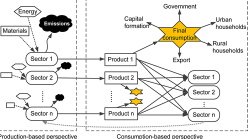
Examining Air Pollution in China Using Production- And Consumption-Based Emissions Accounting Approache
Two important reasons for China’s air pollution are the high emission factors (emission per unit of product) of pollution sources and the high emission intensity (emissions per unit of GDP) of the industrial structure. Therefore, a wide variety of policy measures, including both emission abatement technologies and economic adjustment, must be implemented. To support such measures, this study used the production- and consumption-based e...
-
Lifting China’s Water Spell
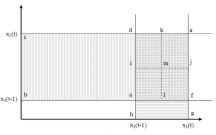
China is a country with significant but unevenly distributed water resources. The water stressed North stays in contrast to the water abundant and polluted South defining China’s current water environment. In this paper we use the latest available data sets and adopt structural decomposition analysis for the years 1992 to 2007 to investigate the driving forces behind the emerging water crisis in China. We employ four water indicators i...
-
The socioeconomic drivers of China's primary PM2.5 emissions
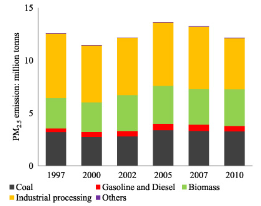
Primary PM 2.5 emissions contributed significantly to poor air quality in China. We present an interdisciplinary study to measure the magnitudes of socioeconomic factors in driving primary PM 2.5 emission changes in China between 1997–2010, by using a regional emission inventory as input into an environmentally extended input–output framework and applying structural decomposition analysis. Our results show that China's significant ef...
-
China’s international trade and air pollution in the United States
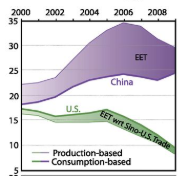
China is the world’s largest emitter of anthropogenic air pollutants, and measurable amounts of Chinese pollution are transported via the atmosphere to other countries, including the United States. However, a large fraction of Chinese emissions is due to manufacture of goods for foreign consumption. Here, we analyze the impacts of trade-related Chinese air pollutant emissions on the global atmospheric environment, linking an economic-e...
-
Modeling imbalanced economic recovery following a natural disaster using input-output analysis
Input-output analysis is frequently used in studies of large-scale weather-related (e.g., Hurricanes and flooding) disruption of a regional economy. The economy after a sudden catastrophe shows a multitude of imbalances with respect to demand and production and may take months or years to recover. However, there is no consensus about how the economy recovers. This article presents a theoretical route map for imbalanced economic recovery ...
-
China’s water management – challenges and solutions
China has experienced enormously rapid development since the open door policy introduced in 1979. Population has increased by 30% to 1.3 billion, and the annual GDP growth rate is at 9.8 %. Nevertheless, frequent water disasters of recent years have caused significant damage to China’s regional growth and societies. There are huge contemporary challenges for Chinese water resources management. In this paper, we examine three major cha...